
Why an off-grid solar air conditioner is the hardest thing to power
Running an off-grid solar air conditioner in a Georgia summer sounds simple until you try it. When a storm knocks out power across Metro Atlanta, the temperature inside climbs fast, and more homeowners around Stockbridge are asking whether solar and battery backup can actually run their AC. The answer is yes, but the air conditioner is the single thing that breaks most of these setups, and one step in the build is never a DIY job. Here is how it really works
The honest answer is yes, but not the way most people think. If you have seen the videos where someone builds an off-grid system for around $13,000 that a company quoted at $100,000, the savings are real. What those videos gloss over is that the air conditioner is the single thing that breaks most of these setups, and that one step in the build is not a DIY job under any circumstances. Here is how it really works.
Why your air conditioner is the hardest thing to power
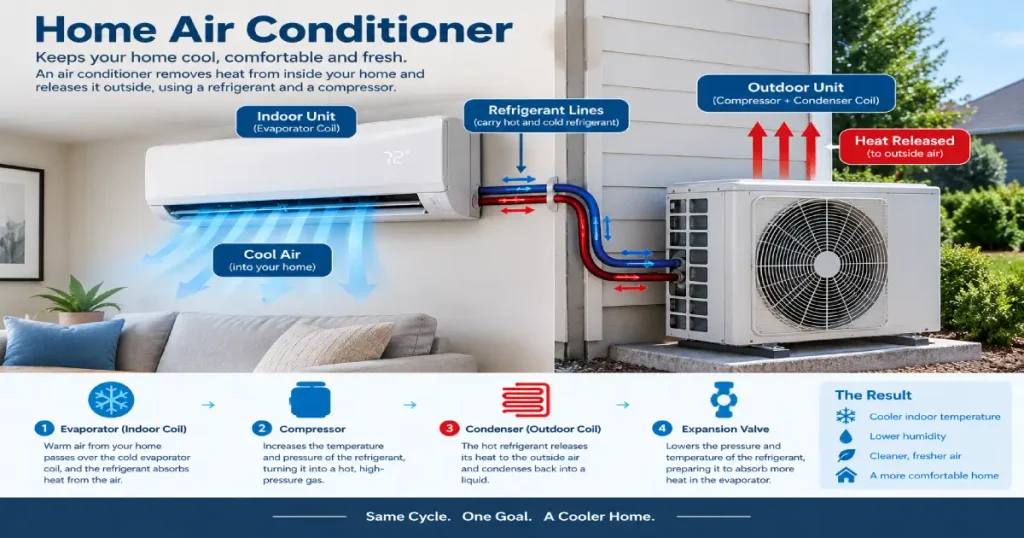
Everything with an electric motor in it, your well pump, your fridge, your washer, and above all your AC compressor, pulls a huge burst of power the instant it starts, then settles down to something modest.
The reason is simple physics. A spinning motor pushes back against the electricity feeding it, which keeps the current in check. But a motor sitting still has no pushback at all. For that first fraction of a second, the power supply is looking at little more than a coil of copper wire, which behaves almost like a dead short. That startup spike is called locked rotor amps, and it is stamped on the data plate of every air conditioner ever made, usually written as LRA.
The numbers are eye-opening. A typical central AC might list 120 amps at 240 volts on startup. That is roughly 28,800 watts in that first instant. A strong home inverter might only deliver 12,000 watts. So the compressor asks for more than twice what the entire system can produce, the inverter protects itself and shuts down, and you are left sitting in a hot house with a full battery bank and no cooling.
The $400 fix almost nobody mentions
The solution is a device called a soft starter, and it is the highest-value part in the whole build. It wires into the compressor’s control circuit and refuses to slam the motor with full power right away. Instead it ramps the voltage up over a couple of seconds, letting the motor start turning gently and build its own pushback before the full load hits.
Same air conditioner, same cooling, completely different startup. That 120 amp spike drops to around 34 amps, roughly 8,000 watts instead of 28,000. Now it fits comfortably inside a 12,000 watt inverter with room to spare. For about $400 in parts, it is the difference between a system that runs your house and a system that runs your lights.
Size the system around your AC, not the panels
Most people start by picking solar panels because panels are the visible part. That is backwards. A system is a chain: the panels gather energy over the day, the batteries decide how long you can go without sun, and the inverter decides what you can switch on at any single moment. The inverter is the real limit, and your air conditioner is usually the biggest thing it has to handle.
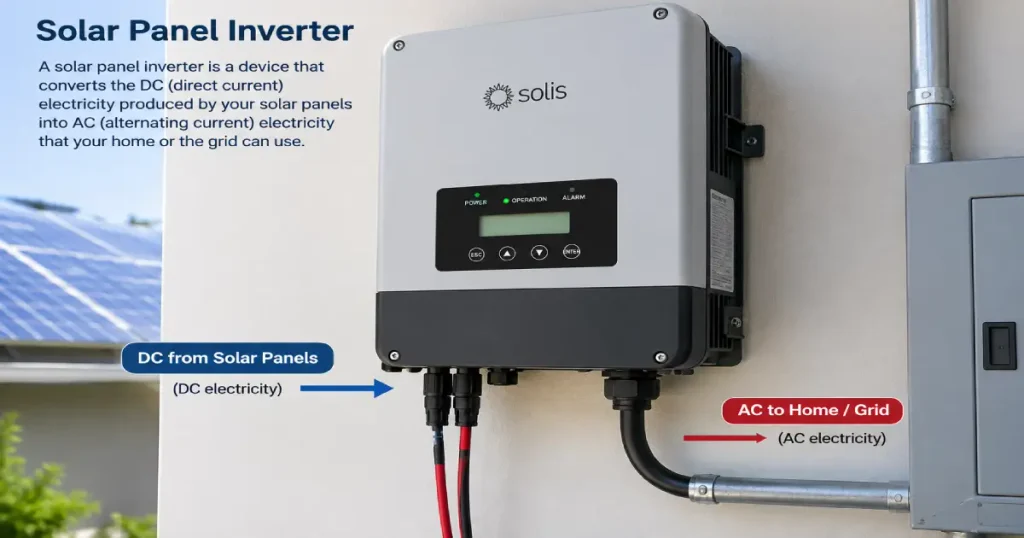
So the order that works is: find the LRA on your AC, decide whether you are adding a soft starter, then size the inverter to cover it, and build the panels and batteries around that. Do it in the other order and you can end up with a roof full of panels that still cannot start your compressor.
The part you should never DIY
Here is where we have to be direct, because this is a safety issue, not a preference.
Connecting your system to your home is done through a proper inlet, a dedicated breaker, and a mechanical interlock on your electrical panel. The interlock is a shaped piece of steel that makes it physically impossible to feed power to the grid and pull from it at the same time. That matters because if power flows backward out of your house, through your meter, and onto the utility line, it gets stepped up to thousands of volts on a line that a utility worker has switched off and believes is dead. An interlock removes that possibility completely. No software, no sensor, nothing to fail.
This is the one job in the entire build where the mistake does not land on you. It lands on a lineman’s family, or your own. It is also where permits, code compliance, and your homeowner’s insurance all come into play. Battery storage over 1 kWh in a home is required by code to be listed and installed to specific clearances, and if there is ever a fire from any cause, an insurance adjuster who finds a non-compliant, self-wired energy system is a conversation you do not want to have.
That is where a licensed electrician earns the fee. Not to sell you hardware you do not need, but to do the connection safely, to code, and in a way your insurer will stand behind.
What you can do yourself, and what to leave to us
There is no shame in doing the parts you are comfortable with. Plenty of homeowners handle their own panels, mounts, and battery racking. The line worth drawing:
Reasonable to DIY: ground-mounting panels, running low-voltage battery wiring, mounting the equipment.
Call a licensed pro: the soft starter install on your compressor, the interlock or transfer switch, the inverter-to-panel tie-in, and anything that touches your main electrical panel or your utility connection.
Serving Stockbridge and Metro Atlanta
Mr. Dee’s Electric Service handles the parts of a solar and backup project that have to be done right the first time. We install AC soft starters so your compressor can run on battery power, we install generator interlocks and whole-house transfer switches so you can switch to your own power safely and legally, and we handle inverter and battery tie-ins to your panel with the permits and code compliance that protect your home and your coverage.
If you are planning an off-grid or backup system anywhere in Stockbridge or the greater Metro Atlanta area, or you already have the gear and need it connected safely, reach out. We will tell you honestly what you can handle yourself and where a licensed electrician is worth every penny.